
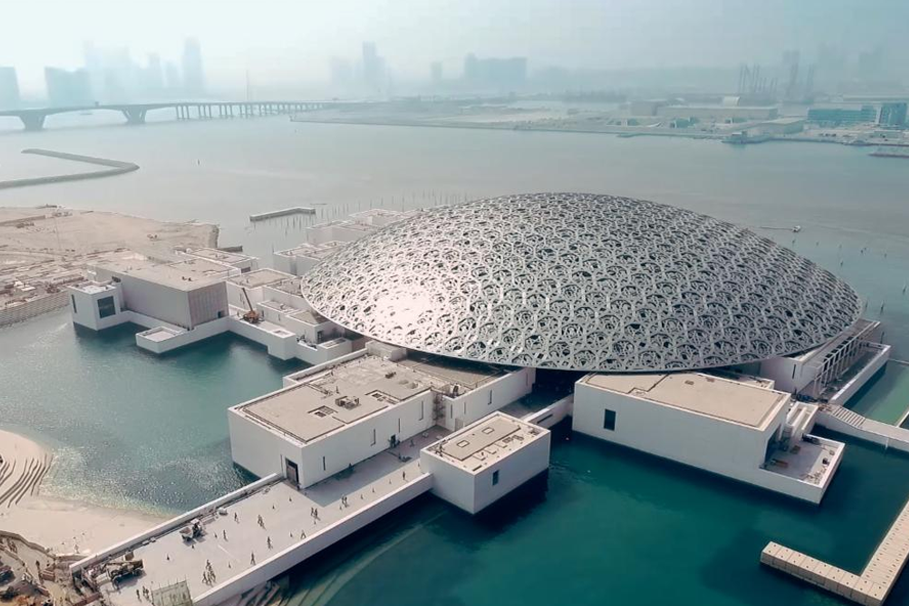
Louvre Abu Dhabi (roof structure) | Grasshopper Script + 3D Model
(Grasshopper & 3D Model) Louvre Abu Dhabi (roof structure)_Case Study
$15.00
(Grasshopper & 3D Model) Louvre Abu Dhabi (roof structure)_Case Study
Customers will receive an email with a link to download the files.
Grasshopper Script of Louvre Abu Dhabi Roof Structure.
3DModel (Rhino3D) compatible with Rhino5 is also inculded in the files
Designed by French architect Ateliers Jean Nouvel, Louvre Abu Dhabi comprises 55 buildings laid out in an organised jumble beneath a giant, silvery, lattice dome. This 180m-diameter cupola is made up of eight layers of steel and aluminium, which form 7,850 star-shaped perforations of various sizes. Through these gaps, sunlight dapples the azure waters of the Arabian Gulf surrounding the complex, and mottles the white walls of the museum’s 23 permanent galleries.
The Emirati art gallery opened in November and is home to some of the world’s most valuable artworks. It is supported by Agence France-Muséums (AFM), the organisation of which the Paris Louvre is a part. AFM indicated precise environmental criteria for the gallery spaces to the Department of Culture and Tourism – Abu Dhabi (DCT) and Louvre Abu Dhabi.
‘Gallery conditions were recommended at 21°C, plus or minus 1°C, and 50% relative humidity (RH), plus or minus 5%,’ says Mark Owen, associate director at BuroHappold Engineering, the project’s MEP engineers. This is no easy task in an Emirate where summer temperatures can reach 45°C and RH levels in winter can exceed 60%.
In addition to the galleries, the strict environmental criteria had to be maintained in four vestibule areas, a highly secure conservation building, and some back-of-house spaces; the requirement even applied to some of the lifts and lift shafts.
For the non-gallery areas of the 58,000m2 scheme – including the cluster of entrance buildings, the ubiquitous shop, a gourmet restaurant, cafeteria, children’s gallery and an auditorium – AFM set a slightly more relaxed design criteria of 21°C +/- 5°C and 50% RH +/- 5%. ‘There are two levels of environmental control: close control and not quite so close control,’ laughs Owen.
AFM also set criteria for airflow in the galleries, which it wanted to flow over the artworks in a laminar fashion, to avoid hot or cold spots. ‘We couldn’t use displacement ventilation, for example, because that would have created temperature stratification, and AFM would not permit a temperature differential to occur across any of the artworks,’ explains Owen.
Ventilation
The engineers were helped in developing the ventilation solution by the galleries’ low fabric-infiltration rate. ‘To protect the art from pollution, sand, temperature and humidity fluctuations – and to save energy – the client specified an infiltration rate of just 2m3/m2.h at 50Pa,’ says Owen. With the exception of the aluminum and steel dome, the complex and its two basement levels are constructed from cast in-situ concrete, up to one metre thick in places. Envelope construction is the same for all the galleries, although the size, shape and volume of each one is different.
Designed by French architect Ateliers Jean Nouvel, Louvre Abu Dhabi comprises 55 buildings laid out in an organised jumble beneath a giant, silvery, lattice dome. This 180m-diameter cupola is made up of eight layers of steel and aluminium, which form 7,850 star-shaped perforations of various sizes. Through these gaps, sunlight dapples the azure waters of the Arabian Gulf surrounding the complex, and mottles the white walls of the museum’s 23 permanent galleries.
The Emirati art gallery opened in November and is home to some of the world’s most valuable artworks. It is supported by Agence France-Muséums (AFM), the organisation of which the Paris Louvre is a part. AFM indicated precise environmental criteria for the gallery spaces to the Department of Culture and Tourism – Abu Dhabi (DCT) and Louvre Abu Dhabi.
‘Gallery conditions were recommended at 21°C, plus or minus 1°C, and 50% relative humidity (RH), plus or minus 5%,’ says Mark Owen, associate director at BuroHappold Engineering, the project’s MEP engineers. This is no easy task in an Emirate where summer temperatures can reach 45°C and RH levels in winter can exceed 60%.
In addition to the galleries, the strict environmental criteria had to be maintained in four vestibule areas, a highly secure conservation building, and some back-of-house spaces; the requirement even applied to some of the lifts and lift shafts.
For the non-gallery areas of the 58,000m2 scheme – including the cluster of entrance buildings, the ubiquitous shop, a gourmet restaurant, cafeteria, children’s gallery and an auditorium – AFM set a slightly more relaxed design criteria of 21°C +/- 5°C and 50% RH +/- 5%. ‘There are two levels of environmental control: close control and not quite so close control,’ laughs Owen.
AFM also set criteria for airflow in the galleries, which it wanted to flow over the artworks in a laminar fashion, to avoid hot or cold spots. ‘We couldn’t use displacement ventilation, for example, because that would have created temperature stratification, and AFM would not permit a temperature differential to occur across any of the artworks,’ explains Owen.
Ventilation
The engineers were helped in developing the ventilation solution by the galleries’ low fabric-infiltration rate. ‘To protect the art from pollution, sand, temperature and humidity fluctuations – and to save energy – the client specified an infiltration rate of just 2m3/m2.h at 50Pa,’ says Owen. With the exception of the aluminum and steel dome, the complex and its two basement levels are constructed from cast in-situ concrete, up to one metre thick in places. Envelope construction is the same for all the galleries, although the size, shape and volume of each one is different.
(Grasshopper & 3D Model) Louvre Abu Dhabi (roof structure)_Case Study

